 KHIZHNYAKOV
How to Price Handmade Products (and Know Your Real Profit)
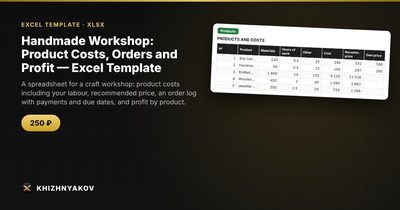
Handmade Workshop: Product Costs, Orders and Profit — Excel Template — Open the template →
Many makers price by looking at what others charge, or by doubling the cost of materials. Both methods quietly leave out the most expensive ingredient: your time. The result is a busy workshop that barely earns anything.
This guide gives you a pricing formula that covers materials, labor and overhead, a worked example in dollars, and a simple way to track orders and payments so you can see what each product really earns.
The pricing formula
Cost per item = materials + (hours × hourly rate) + other costs
Price = cost × (1 + markup)
Each part matters:
- Materials: everything that goes into one item, at the price you actually paid (including shipping to you).
- Hours × rate: the time to make one item, including prep and finishing. Decide what an hour of your work is worth; many makers start at what they would earn in a comparable job.
- Other costs: packaging, labels, a share of tools and equipment wear, and selling fees if you don't add them separately.
- Markup: the profit for the business itself, on top of paying you for your time. It funds growth, slow months and new tools.
Worked example: a soy candle
| Item | Cost |
|---|---|
| Wax (8 oz) | $3.20 |
| Fragrance oil | $2.10 |
| Glass jar | $1.80 |
| Wick | $0.30 |
| Label | $0.40 |
| Materials | $7.80 |
| Labor: 0.5 h × $25 | $12.50 |
| Packaging and other | $1.20 |
| Cost | $21.50 |
With a 40% markup: $21.50 × 1.4 = $30.10. Rounded, a price of $30 to $32 makes sense.
If that feels high, check where the time goes. Making candles in batches of twelve might cut labor to 0.25 hours each, bringing the cost down to $15.25 and a 40% markup price to about $21.35. Efficiency, not underpricing, is how you become competitive.
In Excel, with materials in B2, hours in C2, rate in a settings cell named Rate, other costs in D2 and markup in a cell named Markup:
=(B2+C2*Rate+D2)*(1+Markup)
Don't forget selling fees and taxes
Marketplaces and payment processors take a percentage of the sale. If fees total 10%, either add them to other costs or price so that what's left after fees still covers your target: price = target / (1 − fee share). Taxes depend on where you live and sell; check the rules with a tax adviser, and keep them out of your profit figures.
Track orders, not just prices
A price list tells you what you should earn. An order log tells you what you actually earn. For each order, record: date, customer, product, quantity, price, due date, status (new, in progress, ready, shipped) and amount paid.
- Order total:
=quantity*price - Balance due:
=total-paid - Profit:
=quantity*(price-cost), with cost looked up from your product list via VLOOKUP.
Conditional formatting that turns the due date red when it's within two days and not shipped will save you from awkward messages.
See profit by product
At the end of the month, use SUMIFS to total revenue and profit by product. Results are often surprising: the item you make most may earn the least per hour, while a quick, overlooked product is your best earner. That's the information you need to decide what to promote, reprice or drop.
Common mistakes
- Not paying yourself. If your time is free in the formula, the business is subsidized by you.
- Forgetting small materials. Glue, thread, tape and labels add up.
- Pricing for friends. A friends-and-family discount is fine; a friends-and-family price list is not.
- Not tracking deposits and balances. Unpaid balances on custom orders are easy to forget.
Ready-made template: Handmade Workshop: Product Costs, Orders and Profit
The Handmade Workshop template is a paid Excel file built around this method.
- "Settings": your hourly rate, markup and report date.
- "Products": up to 40 products with materials, hours and other costs; cost, recommended price and markup are calculated automatically. If you enter your own price, it is used in orders and the markup is recalculated.
- "Orders": up to 500 orders with customer, product, due date, status and payment; amount, balance and profit are calculated automatically.
- "Summary": revenue, profit, balance due, sales and profit by product, and a chart.
Taxes and marketplace fees are not calculated separately; include them in other costs or in the price. It works in Excel 2007 and later and in LibreOffice, with no macros.
FAQ
What hourly rate should I use?
Start with what you would need to earn per hour in a comparable job, then sanity-check the resulting prices against the market. If they are far above what customers pay, work on speed and batching before cutting your rate.
Should wholesale prices follow the same formula?
Wholesale buyers typically expect to roughly double your price for retail. Your wholesale price must still cover your cost and some profit, so calculate retail pricing with that in mind.
How do I price one-of-a-kind custom pieces?
Use the same formula with an estimate of hours, and add a buffer for revisions and communication. Take a deposit that covers at least materials.
How often should I review prices?
When material prices change, and at least once a year. Raising prices by small steps regularly is easier for customers than a big jump later.